News

The Cameroonians of the COP 14, Egypt 2018

Although Green Connexion and Coeur d’Afrique of his Excellency Roger Milla are the only Cameroonian Non-Governmental Organizations to have been officially invited to COP 14, the fact remains that Cameroon is member of the CBD. As such, the country is represented in Egypt by an official delegation, but also by other Cameroonians from different backgrounds and origins. In the corridors of COP 14 and in the role of observer assigned to it, Green Connexion met some of these Cameroonians of the CBD, and that he presents you below:

Dr. GHOGUE Jean-Paul
Green Connexion’s Coordinator

Mme Prudence GALEGA
CBD’s Focal Point – MINEPDED

Mme Aurèlie DINGOM Taylor
ABS’s Focal Point – MINEPDED

Sa majesté Honorable LEKUNZE NEMBO Andrea
Senator and King of the Bamumbus

Dr. NGUENANG Guy Merlin
GIZ

Maimuna UMARO
REPALEAC

NGUTY NKENG Elisabeth
WWF

Mr NTEP Rigobert
MINEPDED

Mme AYI Monique Epse NKAMGNA
Mayor of Dzeng

Mr Stanislaus LEBAGA
MINEPDED

Aliou MUSTAFA
GEF SGP

Mme FANTA Sylvie
MINEPDED

TAMOIFO Marie
MINEPDED

Marcelin BEMA
MINEPDED

Mme Priscilla SONG
MINEPDED

MBAH Peter NFORSI
CRTV

NGEFOR Anita NGU
MINEPDED

Green Connexion participates in COP 14

A view of the sign of the conference in Sharm El Sheikh. @greenconnexion. November 17th, 2018.

Green Connexion was honored this year by being invited to participate in COP 14 (Fourteenth Conference of the Parties to the United Nations’ Convention on Biological Diversity (CBD)), held in Sharm El Sheikh, Egypt. 17 – 29 November 2018. The theme of COP 14 is “Investing in Biodiversity for People and the Planet”. By putting people in the center and even in front of the planet, this theme draws attention to the primordial role of the human being in the preservation of his unique space, the planet earth. The earth is indeed our host and our nanny. Although it may have several characteristics (agriculture and small-scale hunting, collection and marketing of products derived from biodiversity, definition of exploitation policies, etc.), investing in biodiversity always has an economic and conservation character. So we do it for ourselves and for the planet that hosts us.

To sit as an observer  

Green Connection sits as Observer. If it cannot participate in the decisions (to take part in the votes), it can attend the meetings, participate in debates and, in this chapter, its long experience in the field biodiversity conservation counts. By inviting Green Connexion and many other Non Governmental Organizations (NGOs) around the world, the United Nations is leveraging all its credibility resources to add value to the global event that is COP 14.

Dr. GHOGUE Jean-Paul, Coordinator of Green Connexion, posing next to the acronym for COP 14 (Sharm El Sheikh, November 17, 2018).

A universal summit

Apart from the objective of developing and maintaining the Convention on Biological Diversity, the approximately 2500 participants at COP 14 come from all over the world. They are represented by the parties (196 to date), observers, NGOs, researchers, industrialists etc. Through the clothing port at the opening, one can witness the impressive diversity that constitutes the world culture in its totality. Another great diversity is expressed through the multitude of parallel events organized and the great variability of individual interests or distinct groups.

Green Connexion and the 25 years of the CBD

Green Connexion is a relatively young organization. It’s created in the years 2011 only. However, to date, it has made its way in the field of conservation. It has already to its credit most of what is known about the conservation of freshwater aquatic plants in Central Africa. As such, it has demonstrated this year the 25th anniversary of the Convention on Biological Diversity with the splendor justified by this enthusiasm that is generally found among the youngest. And the organization is coming to Sharm El Sheikh with a lot of confidence.


Some photos

Forward and from left to right: Dr. GHOGUE Jean-Paul (Coordinator of Green Connexion); His Majesty Senator Lekunze Nembo Andrea (Superior Chief of the Bamumbu Group (SW)); Mohamadou Labarang (Ambassador of Cameroon to Egypt); Mrs. Prudence Galega (CBD Focal Point – Cameroon). @greenconnexion, November 17, 2018.


Joyful view at the Cameroon stand in Sharm El Sheikh @ greenconnexion, November 17, 2017.


Dr. GHOGUE Jean-Paul, coordinator of Green Connexion, posing with Egyptian artists. @greenconnexion, November 17, 2018.


By J.-P. Ghogue, Green Connexion, from Sharm El Sheikh, novembre 19, 2018.

Green Connexion and the celebration of the International day for Biological Diversity 2018 : Like a ripe fruit ?

Green Connexion, it’s like a child: Very enthusiastic … Nevertheless, on the road, it knows it can count on the adults, the elders.

May & Nukia, young students at University of Yaoundé I, during the celebration of the International day of Biological diversity the 22 Mai 2018. @greenconnexion photos. 2018.

25 years old this year. Already ? – Would ask some. 25 years, it’s far. It’s like the distance from here to Rio de Janeiro, and Green Connexion was not born yet. Grown up with its history, no need to go across the wall of time.

Since 2013, Green Connexion has remained well connected with the celebration of the International day of Biological Diversity, sometime alone, but more often with the company of the elders (Ministry of Environment, IUCN, Nachtigal Hydropower Company, WWF, CIFOR and I am forgetting).

The Green Connexion team, during a protest march the 22 may 2013 in Yaoundé. @greenconnexion photos. 2013.

2013, when Green Connexion, almost juvenile, was then learning the basics of the art of conservation, was playing drums on the streets of Yaoundé to be heard, jostled habits in the Cameroon hydropower dams, very enthusiastic in fact. It was five years ago. Still!

The relationship between Green Connexion and the International day for Biological Diversity, whose theme in this year 2018 was  “Celebrating 25 Years of Action for Biodiversity” was first emotional, then nostalgic. This theme was enriched by the human greatness, by its universal aspirations, its hopes, its expectations and its enthusiasms, but also by its pettiness, its gravities, its flippancies as well as its laxness. Green Connexion was surely not alone to be totally identified in this theme.

The Green Connexion team posing with the Director and some staff members of WWF – Cameroon. @WWF website 2018.

On the 22 may 2018, more than a fifty of the Green Connexion members have been mobilized to go celebrate in the elder’s house, to meet with them, share their experience on biodiversity and discuss about the future of the world. The CIFOR (Center for International Forestry Research) and WWF (World Wildlife Fund) did them the honour. And the party was beautiful and friendly.

The Green Connexion team, posing with the staff members of CIFOR. @greenconnexion photos. 2018.

On the 23 and 24 May 2018, during the delayed celebration of the International Biodiversity Day organized by the Cameroonian Ministry of Environment and Nature Conservation, Green Connexion had the honour to share publicly the stand with IUCN.  In fact, IUCN had chosen Green Connexion as the organization member, model of the close collaboration that it entertains with its members.

Finally, Green Connexion and the International day for Biological Diversity 2018: Like a ripe fruit? That no! Rather like a ripening fruit.

Joint team IUCN-Green Connexion posing in front of their joint stand (Yaoundé 23 May 2018).
From Left to right : Eugène Messina (Station manager Radio Environnement, IUCN) , Suzanne Kamgue (Head of stand-IUCN) ; Mireil Tchoupou Votio (Green Connexion) ; Forbi Preacious Awin (Green Connexion) and Ghogue Jean-Paul (Director – Green Connexion). Photo@UICN photos. 2018

By Jean-Paul Ghogue

Director – Green Connexion.


@Green Connexion 2018.


Download This Content :Green Connexion and the celebration of the International day for Biological Diversity 2018 : Like a ripe fruit ?

GREEN CONNEXION’S HEALTH AND SECURITY AT WORK

The risks incurred at work are many; all depend of the type of activity. It is an obligation to assure the security of the workers in all areas of work; hence an assessment of the risks must be done in order to protect the lives of the workers.

Clear instructions are given before any operation

At this moment, the main work environment of Green Connexion is aquatic (streams and rivers). This ubiquity in water demands for good assessment of the risks incurred in this type of environment.

Working in an inhospitable environment

The main risk working in waters being drowning, several other risks exist such as sprains, wounds, hurts, fracture of body members and the chemical or biologic risks (Water pollution, contamination to onchocerciasis or river blindness etc.). Green Connexion pays particular attention to the well-being of her members.

Green Connexion organizes yearly training sessions in nautical first-aid in order to teach participants the basic notions in first-aid; and its members regularly visit specialists for onchocerciasis’ controls.

The trainings take place in an alternation of theoretical and practical phases. The theoretical phase first of all consists of listing the different types of first-aid; the nautical first-aid being the main aim of the training, more attention is given to it.


Close protection for less risk

Training by example

First of all, learners are endowed with nautical first-aid notions, followed by the presentation of the security measures to be taken for an activity in aquatic environment: to always have first aid kits; to be accompanied always by at least a swimming expert, to carry the Individual.

Floating Clothing (IFC) or of a life jacket; to carry an adapted helmet, non-skid shoes and mountaineering ropes (for those that are going to sail in the rocky zones or the cascades).

One of the major points of the training is the presentation of the different types of accidents which are likely to occur, as well as the emergency measures to be taken in case of drowning, sprain, injury, and fractures of body members.

Example of what to do in case of leg’s fracture

Lateral position of security

Hence, participants are taught that in case of drowning or submersion, the first thing to do is to take the victim out of water, cover him immediately,

and to alert the emergency units and begin to treat him. If the victim is conscious and breaths normally, after having dried and covered, he is put in a half sitting position. If he starts coughing or spitting water by the nose or the mouth, he should be placed in lateral position of security to facilitate the evacuation of the fluid. In the same way, manipulations of victims who have lost memory but breathing normally, not breathing at all or breathing in an irregular manner are demonstrated.


NB: The set of manipulations should not last any more 30 to 40 seconds.

Usage of triangular scarfs

For the cases of sprain and strain, an elastic bandaging is recommended as well as for the cases of injuries. In the same way, it is always advisable not to tighten the bandaging otherwise it is going to reduce blood circulation. Bandaging should be done at the most distant point from the heart. In case of fracture (arm, forearm, thigh, tibia) techniques of immobilization with the help of the triangular scarfs are advised. Thanks to this initiative, Green Connexion team is always ready to carry through her activities and always move along with a first aid box in every field trip.

A Green Connexion team in the field

Some exploration of Green Connexion

Some exploration of Green Connexion

Gallery Wordpress

Green Connexion et ses membres à l’NHPC pour la journée Mondiale de la Biodiversité

Le projet hydroélectrique de Nachtigal Amont (420 MW), qui comprend la construction de barrages en béton compacté au rouleau (BCR), d’un canal usinier, d’une centrale hydroélectrique dotée de sept groupes de 60 MW et d’une ligne d’évacuation d’énergie jusqu’à Yaoundé, se situe sur le fleuve Sanaga à 65 km de Yaoundé.

Ce projet stratégique pour l’Etat du Cameroun est développé par une société projet camerounaise, Nachtigal Hydro Power Company (NHPC), donc les actionnaires sont EDF International, l’État du Cameroun et la Société Financière Internationale, qui s’est fixée pour ambition de se conformer aux meilleures pratiques nationales et internationales en matière environnementale et sociale, d’aménagement hydraulique et de construction d’infrastructures.


Green Connexion et ses membres à l’NHPC pour la journée Mondiale de la Biodiversité

Gallery Wordpress

Green Connection and its members to IUCN for the World Biodiversity Day

The International Union for Conservation of Nature (IUCN) is amembership Union uniquely composed of both government and civil society organisations. It provides public, private and non-governmental organisations with the knowledge and tools that enable human progress, economic development and nature conservation to take place together.

Created in 1948, IUCN has evolved into the world’s largest and most diverse environmental network. It harnesses the experience, resources and reach of its 1,300 Member organisations and the input of some 16,000 experts. IUCN is the global authority on the status of the natural world and the measures needed to safeguard it. Our experts are organised into six commissions dedicated to species survival, environmental law, protected areas, social and economic policy, ecosystem management, and education and communication.


Visit to IUCN Cameroon

Gallery Wordpress

Green Connexion’s actions for the conservation of freshwater plants

Green Connexion’s actions for the conservation of freshwater plants in Cameroon (2014 – 2016).

Preasious Forbi, Marlène Ngansop T., Mireil Tchoupou V., Eric Ngansop T. & Jean-Paul Ghogue (May 09th 2017).
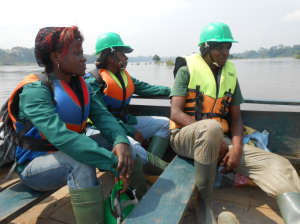
The Green Connexion team during a survey on the Sanaga River. Photo@greenconnexion. 2015.

In Cameroon, we are currently working in the domain of conservation of freshwater plants in the Sanaga, Nyong, Mbam, Ntem and Djikem rivers. We focus mainly on the protection and conservation of plants directly threatened by the construction of retention or hydroelectric dams.

In the Sanaga River, in contract with the Nachtigal hydroelectric project since 2015, we are trying to save from extinction the plants Ledermanniella sanagaensis (CR= Critically Endangered of extinction) and of the Nachtigal falls where the Nachtigal dam will be constructed, Ledermanniella thalloidea (EN= Endangered of extinction) both species belonging
We are carrying out the same work as for the Mbam in the Djikem River which flows into the Sanaga River around Mbandjock.
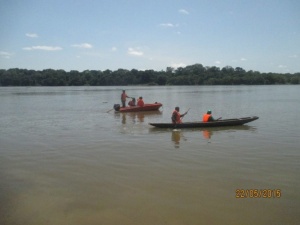
The Green Connexion team on the Nyong River waterfalls at Dipippy. Photo@greenconnexion. 2016.

The Nyong is the second largest river in Cameroon after the Sanaga. Under a sub-contract with Oréade-Brèche working for the Platinum Power company, Green Connexion in 2016 carried out in the above river a short inventory of all freshwater aquatic species and the results showed that it contains many important species from a conservation point of view because they are threatened at different levels. We can cite the following examples: Saxicollela nana (endemic to the Nyong River) and Ledermanniella boumiensis all two (VUD2), Ledermanniella schlechteri, Ledermanniella
bifurcata and Macropodiella heteromorpha, all three (VU B2ab(ii,iii)) and Impatiens letouzeyi (EN).
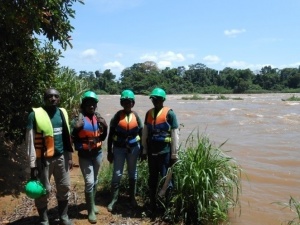
The Green Connexion team during a mapping mission on the Ntem River. Photo@greenconnexion. 2015

Compared to the Sanaga River currently, the Nyong River remains relatively less perturbed. For all projects on this note, the examples of the threatened plants listed above show the importance of the conservation initiatives of freshwater aquatic plants at the base.

Generally, when a big project is carried out on a big water course, even with a good will, in situ conservation actions (on the project site) are often difficult and costly. In this context, the transplantation (removing the threaten species and plant them somewhere else), the search and the conservation of new populations are often envisaged as the best alternative.
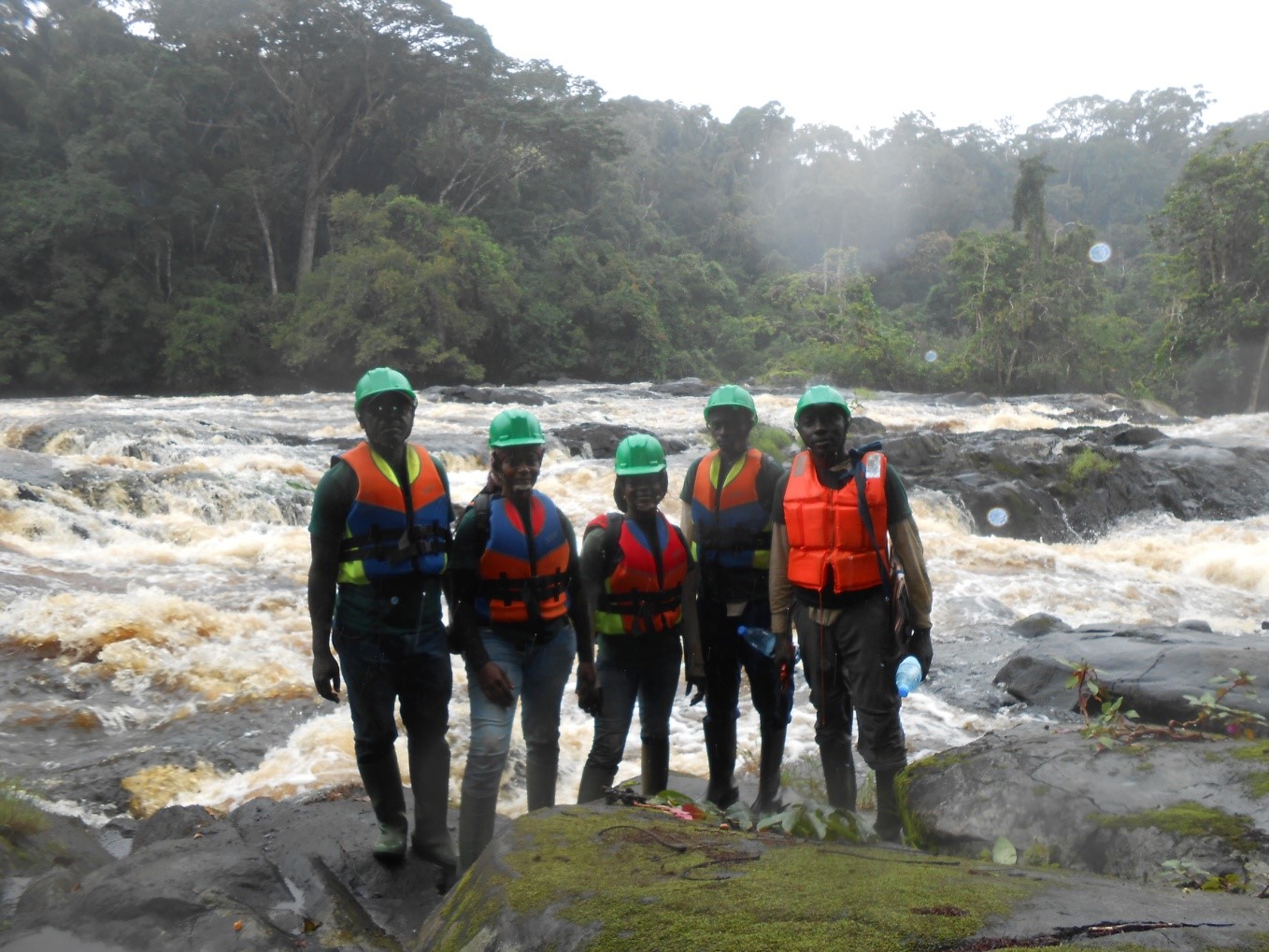
The Green Connexion team during a water sampling on the River Dibang. Photo@greenconnexion. 2014.
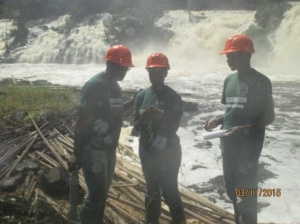
The Green Connexion team  during an inventory on the River Ntem’s waterfalls. Photo@greenconnexion. 2015.
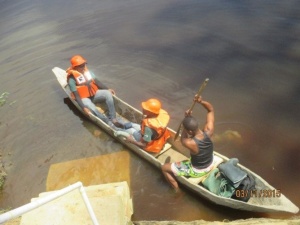
The Green Connexion team during a crossing of the Biwomé River. Photo@greenconnexion. 2015.


However, most freshwater aquatic plants are very eye-catching in terms of the physic anc chemical conditions of the milieu. To guarantee a chance of success to a possible transplantation, the conditions in the source medium should be close to, if not identical, to those in the host medium.

From 2014-2015, under the financing of the Rufford Small Grants, we studied the physico-chemical conditions of water in the Sanaga River at Nachtigal, and at Edéa, and then compared them to those of waters from the Afamba, Mbam, Kelle, Nyong, Dibang, Lep Riton and Ngwei rivers.
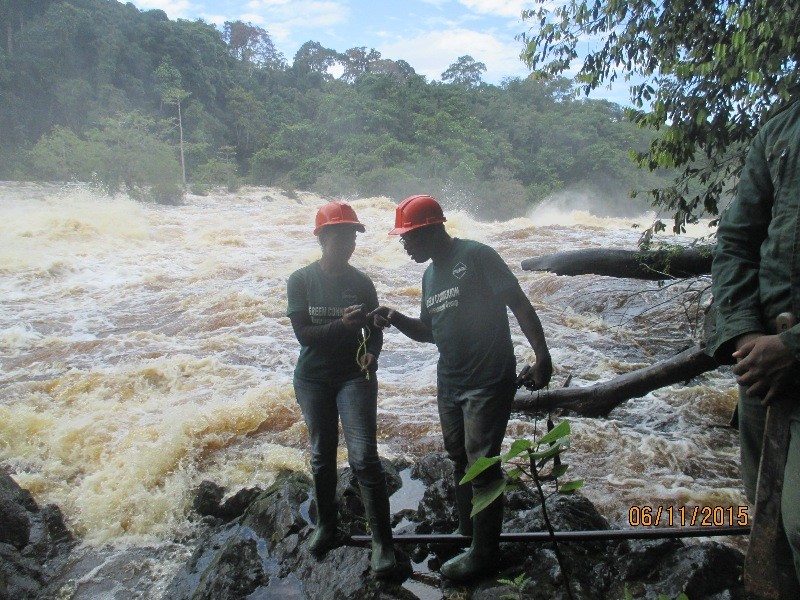
The Green Connexion team during a mapping mission on the Ntem River. Photo@greenconnexion. 2015
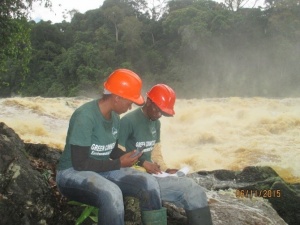
The Green Connexion team during notes taking on the Ntem’s riverside. Photo@greenconnexion. 2015.

Statistically, the physico-chemical characteristics of the Kelle and Lep Riton rivers were closer to those of the Sanaga River at Edéa and at Nachtigal.

Due to this fact, these two rivers constituted the best sites for the potential transplantation of endemic Podostemaceae from the threatened sites of Edéa and Nachtigal. However, these two rivers are not tributary to the Sanaga River. Taking into consideration the size and parental link with the Sanaga River, the Mbam river was also retained as a site for eventual transplantation.
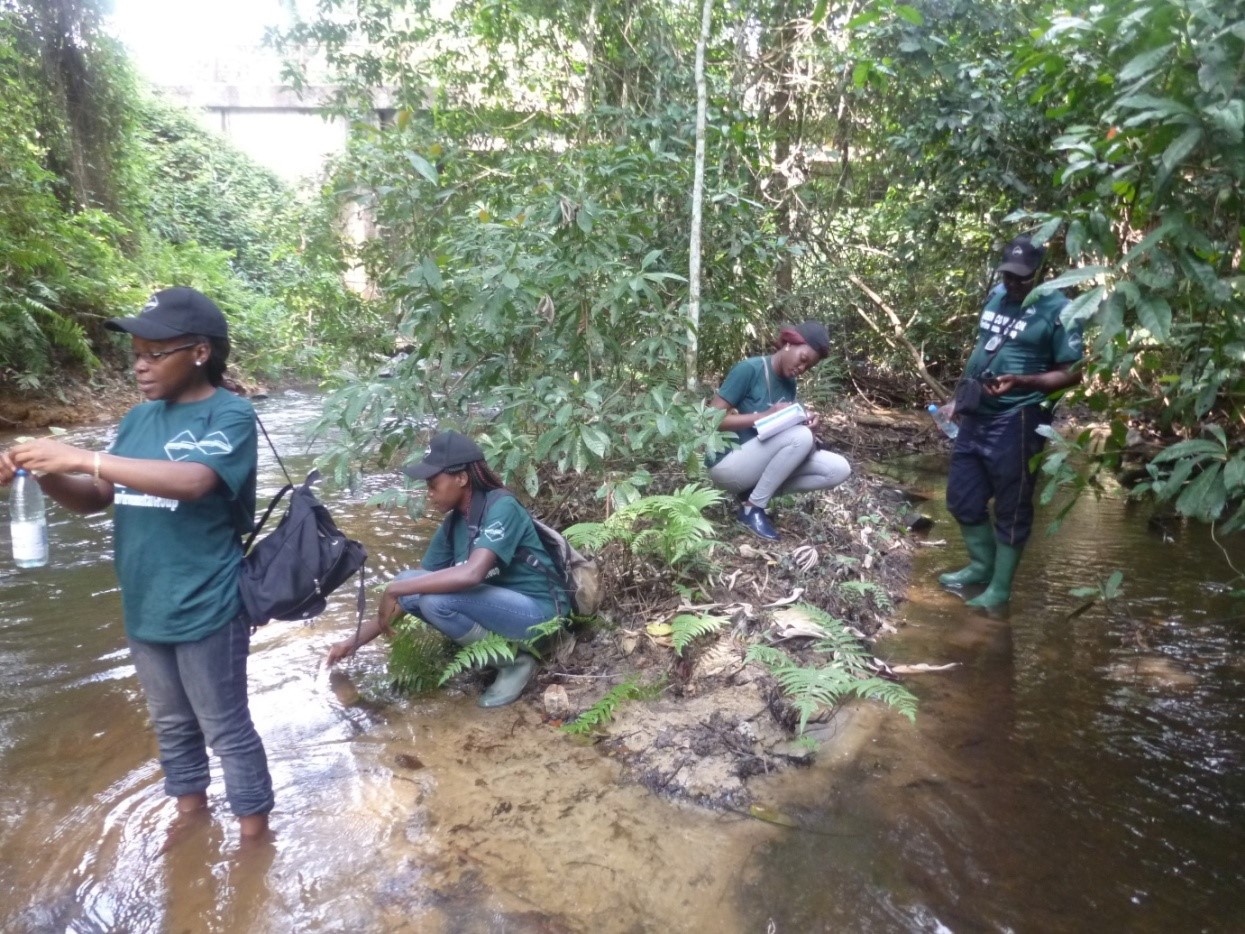
 

The Green Connexion team during a water sampling on the River Dibang. Photo@greenconnexion. 2014.

Perspectives

Cameroon has many dams. Actions to conserve freshwater aquatic plants in the watercourses where these dams are built are, if non-existent, but
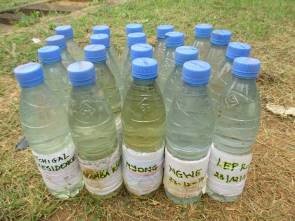
Echantillons d’eau

diverse and isolated. Yet a watercourse holds in all. When several dams are built there, their conservation actions must be concerted and coordinated. In the near future, we envisage,
together with the Cameroon Ministries of Water and Energy, Environment and Nature Protection, IUCN and all stakeholders in the field, the creation of a common platform for reflection and exchange on actions that favor the conservation of freshwater biodiversity in the major rivers of Cameroon.